
As parents, we all share a simple wish: that our children find a calling that challenges them, rewards them and shapes them into leaders of character. A few years ago as a mechanical engineering student myself, my own parents wanted exactly that for me. Today, as a Submarine Officer who commissioned through the Navy's Nuclear Propulsion Officer Candidate (NUPOC) Program, I write this letter to help you understand why this program is such a rare opportunity and why it deserves your family’s serious consideration. In about 18 years, when my son goes to college (which will be paid for by the military's GI Bill Benefits), I hope that he will apply for this program.
This letter is meant to:
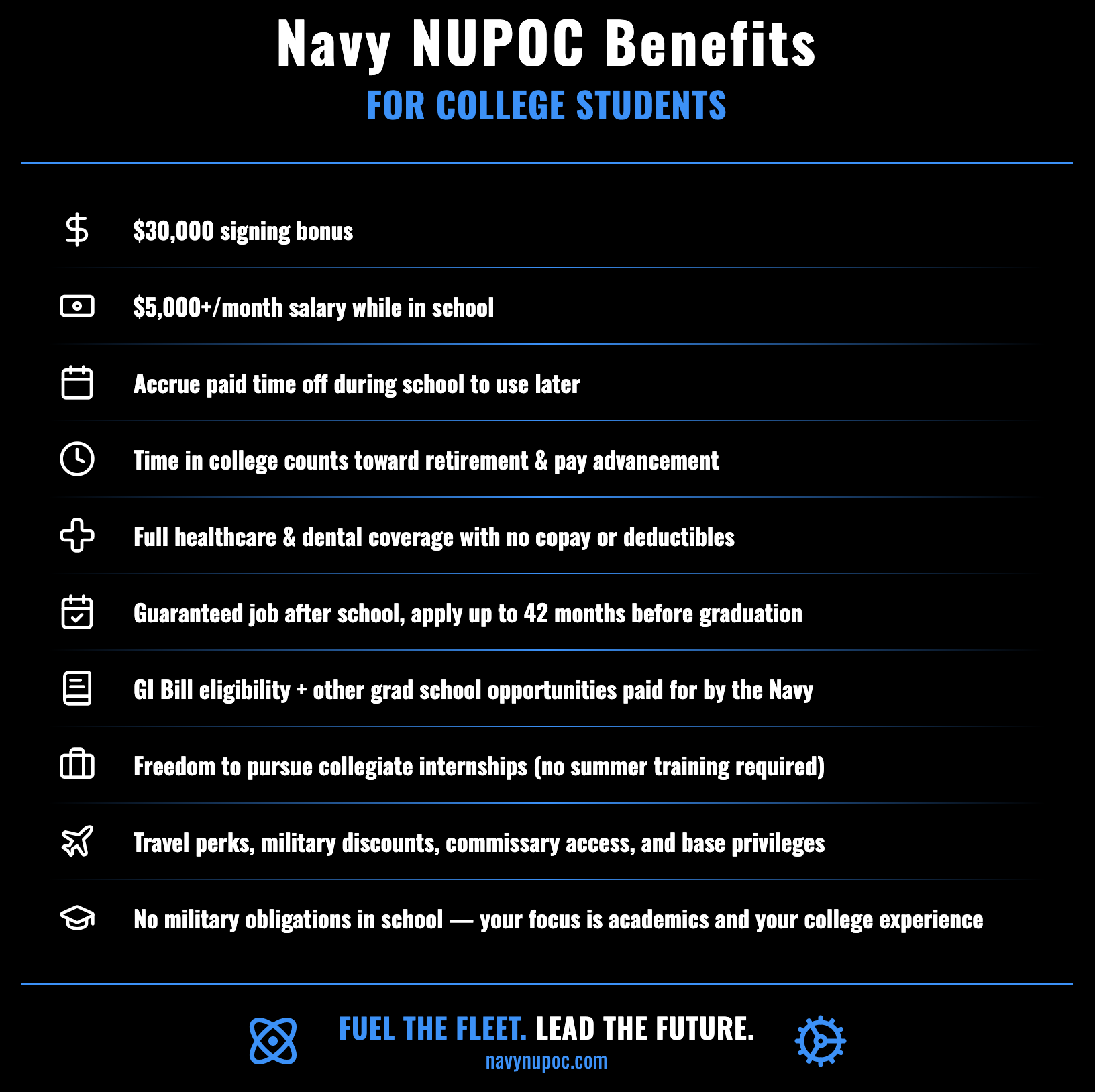
Being selected for the NUPOC program is not “just joining the military.” It is an invitation to become part of one of the most selective leadership pipelines in the nation. From day one, program participants are treated like professionals. Students who are accepted receive a full-time salary – over $5,000 per month – plus a signing bonus of up to $35,000. This pay arrives while they are still enrolled in college, allowing them to focus on their studies and leadership opportunities without juggling part‑time jobs or student loans. They also receive full healthcare and dental coverage upon program acceptance. Time spent in school counts toward their military retirement and salary advancement, meaning that if they join early, your child will graduate with several years of retirement credit already on the books and commission as an officer with a salary of over $100,000 per year and over 60 days of paid time off already accrued.
NUPOC students enter one of several tracks – submarine officer, nuclear surface warfare officer, instructor, or Naval Reactors engineer – each with its own training path. Submarine and Nuclear Surface Warfare Officers attend Officer Candidate School (OCS); Naval Reactors Engineers and Nuclear Instructors attend Officer Development School (ODS). OCS is a 13‑week program in Newport, Rhode Island designed to instill discipline, leadership and naval customs. ODS is a shorter, five‑week version that introduces the Navy’s culture and expectations for professionals such as doctors, lawyers and instructors. After commissioning, students complete nuclear power school and hands‑on training on a real nuclear reactor before reporting to their operational assignments. Throughout this journey they gain practical experience operating reactors, leading teams, and making decisions under pressure – skills that carry enormous weight both inside and outside the Navy.
One of NUPOC’s biggest advantages is the ability to earn a professional salary before graduation. Many college students graduate with tens of thousands of dollars in debt and accept entry‑level jobs paying around $65,000 per year. By contrast, NUPOC students earn more than $60,000 per year while in school, collect their signing bonus of up to $35,000 immediately upon acceptance, and step into a career right out of college making over $100,000 per year. A freshman accepted into the NUPOC program can earn over $300,000 before graduation. That early income can allow students to graduate debt‑free with significant savings. Waiting to join can be costly – every month a student delays is a month of salary and retirement credit that can never be recovered.
NUPOC appointments are limited. Each year there are a finite number of national slots, and historically they fill quickly. Students may apply as early as 42 months before their graduation date. Because acceptance triggers the signing bonus and monthly pay, joining sooner amplifies the financial benefit and reduces the risk of missing out altogether.
Unlike ROTC scholarships or an appointment to the Naval Academy, NUPOC requires no extra classes, no uniform, and no drill commitments during school. The Navy pays students directly, not the university, so they retain freedom to make their own financial decisions. The only program obligations are to stay physically fit, keep getting good grades, and check in with their recruiter semi-regularly.
Because there is no drill requirement, your child has the freedom to pursue internships, co‑ops and leadership roles on campus. They can join clubs, conduct research, study abroad, work at a summer camp, or intern at a Fortune 500 company without the conflicts of any summer training or weekend drills. The Navy simply pays them to be students and encourages them to excel academically while getting a well-rounded experience.
Many worry that joining the military means throwing away academic ambitions or taking a path reserved for those with no other options. This couldn’t be further from reality for this program.
When your child joins the NUPOC program, they aren’t signing up for an enlistment contract. They are becoming commissioned officers, leaders entrusted with managing nuclear propulsion plants that power submarines and aircraft carriers. Officers are trained to think critically, make ethical decisions and lead teams of highly skilled sailors. They are not the sailors turning wrenches; they are the ones planning missions, enforcing safety protocols and ensuring the success of complex operations. The NUPOC program is such a great deal because we need talented leaders for our missions, and the private sector fiercely competes for the same talent.
This program is similar to ROTC and the USNA in that it leads to the same commission and training, but the experience in college is significantly different – there are no extra classes, no uniform requirements, no training until after graduation, and the pay goes directly to the student.
In fact, NUPOC enhances college life. Because financial stress is removed, students can join clubs, conduct research, study abroad or intern at civilian companies without worrying about paying rent, working part‑time, or worrying about the job market and finding a job after graduation. They can fully participate in campus traditions and seek leadership positions. The Navy only asks that they maintain a minimum GPA and stay physically fit. There are no surprise drills, and recruiters check in regularly to ensure students are thriving, not to intrude.
OCS and subsequent nuclear schools are rigorous because they must be. These officers will operate multi‑billion‑dollar reactors and lead sailors in stressful situations. However, the vast majority of candidates graduate successfully, and they enter training with an extensive support network. No prior nuclear experience or expertise is required - the Navy will teach them everything they need to know. For technical professionals (Naval Reactors Engineers and instructors), ODS is shorter and less physically demanding. It is closer to an orientation – a manageable introduction to Navy life. The goal of these schools isn’t to weed out but to build up; they transform students into leaders capable of safely operating reactors and making life‑and‑death decisions.
Submarine and Surface Warfare officers do serve at sea, but their first deployments come after plenty of training, and even while attached to a ship more time will be spent in port training and overseeing maintenance. Submarine Officers are typically assigned to a submarine for 30-32 months with a few deployments lasting 2–6 months (warships are typically in port more often than they are at sea). Surface Warfare officers also typically deploy for 3–6 months at a time. After periods of being assigned to a ship, officers enjoy shore assignments, graduate education, or instructor roles.
Naval Reactors engineers and instructors do not deploy; they typically live and work in Washington, D.C. or Charleston, South Carolina. Home ports are in located in beautiful coastal cities, so if your family wants a reason to visit places such as Hawaii or California, the Navy can make those vacations part of everyday life.
The opposite is true. NUPOC graduates emerge with five years of leadership experience, advanced technical training and a track record of managing complex systems. Fortune 500 companies, national laboratories and top graduate schools actively recruit former nuclear officers. Many alumni pursue fully funded graduate degrees through the GI Bill, Navy Postgraduate School, and other educational programs or transition into industries such as energy, aerospace, finance and technology. Others remain in the Navy, rising to command or policy roles. NUPOC opens doors; it doesn’t close them.
NUPOC students generally incur a five‑year active duty commitment after commissioning. This includes all nuclear training – and once those five years are complete, your child can transition to civilian life or continue their naval career. It’s important to view this commitment in context: your child receives years of world‑class training, leadership experience and professional pay before they ever set foot on a ship. In many civilian industries, professionals spend decades acquiring comparable responsibility and leadership experience.
The Navy’s nuclear program is world‑renowned for its emphasis on integrity, procedural compliance and forceful backup – qualities that align with the values many families seek to instill. In my experience, the nuclear pipeline produces officers who think deeply about the “why” behind every procedure and who live by a strict code of accountability. When I first stood watch on a nuclear submarine, I saw firsthand how this training fosters calm, principled decision‑makers. If you want your child to develop character as well as competence, NUPOC offers a framework that few institutions can match.
The NUPOC program embodies the principle of reciprocity: the Navy invests in your child up front so that they can serve with distinction tomorrow. Candidates commit to five years of active duty after commissioning and a brief period in the inactive reserve, and in return they receive world‑class training, leadership development and financial stability. As parents, you have taught your children the value of keeping promises and following through. Choosing NUPOC continues that lesson by honoring a commitment to something larger than oneself.
It is also important to be honest about the sacrifices inherent in naval service. For those on the submarine or nuclear surface warfare tracks, deployments are part of the job. Submarine officers will spend about 32 months attached to a submarine in those first 5 years, and the career overall rotates between sea tours and shore duty. Deployments themselves are measured in months rather than years; fast‑attack and guided‑missile submarines usually sail for three to six months at a time, while ballistic‑missile submarines patrol for about three months. Between deployments, crews spend significant time in their home port for maintenance, training and local operations, and officers can take some paid time off (leave).
Leaving family behind is difficult. On my first submarine tour I deployed a few months after my son was born. I missed his first smile. Although there are incredible experiences at sea, such as seeing foreign ports, forging friendships, operating cutting‑edge technology, and executing high stakes missions, there were also evenings when I longed to be home reading bedtime stories. My wife shouldered the load at home (and spent much of the time I was away back home with her parents). I missed them dearly. Every day, I reminded myself that the sacrifice I was making was worth it because it helped ensure my family and yours could sleep safely at night.
When your son or daughter is out there serving with distinction, you may not know exactly where they are, but you will be proud knowing they are fueling jets that defend freedom or ensuring that our nuclear deterrent remains credible. There is a reason people thank service members for their service: it isn’t easy. But it is deeply meaningful.
However, in the Navy you are not always attached to a sea-going vessel. We strive to balance service and family. After a sea tour, officers often receive a shore assignment where they often work less than 40 hours a week, and have time to pursue advanced education or other pursuits. These rotations allow sailors to be home every night, start their family, and coach their kids’ sports teams. If your child chooses the Naval Reactors engineer or instructor track, they will not deploy at all; they will live and work at shore sites overseeing training and reactor design. Even for those who go to sea, the pattern of deployment and shore duty means there are long periods of normalcy to offset the months at sea.
Thousands of Navy families have walked this path with plenty of support and resources available to them. Family readiness groups, ombudsmen and networks of spouses provide childcare, counseling and a sense of community during deployments. These hardships also develop resilience, leadership and personal growth. Facing challenges at sea and overcoming them builds character and forges lifelong bonds. Understanding these realities helps parents make informed decisions. NUPOC offers tremendous rewards—technical mastery, leadership growth, financial independence and the honor of defending our nation—but it also requires resilience and a willingness to place service above self. If your child chooses this path, know that the Navy will support them and your family every step of the way.
I know this was a longer letter, but I'm glad you have made it this far, and I hope you now see why joining the NUPOC program is far more than just “joining the military.” It is a prestigious, financially transformative program that prepares young men and women to lead with competence, integrity and courage. As someone who completed the program and has finished my five‑year commitment, I can say that it challenged me in ways that no classroom ever did and rewarded me with confidence, lifelong friendships and a sense of purpose. The skills I have developed – systemic thinking, problem solving, leadership under pressure, disciplined time management and steadfast integrity – have served me in every sphere of life.
If your son or daughter is considering the NUPOC program, please explore our website, try out the pay calculator, and read more in-depth about the different career options. The FAQ at the bottom of this page is an excellent resource. Please reach out through our contact form if you have questions or would like to speak with me directly. I’m always happy to connect parents with current students in the program or alumni so you can hear their stories firsthand.
Your support can make all the difference in whether your child embraces this opportunity. Encourage them to apply early, and be prepared to watch them grow into leaders who fuel the fleet and lead the future!
Sincerely,

LT Cooper McCall, USN
US Submarine Officer
Navy College Engineering Programs
The following are a few further resources to investigate if you want to do more of a deeper dive on this program.
The Nuclear Propulsion Officer Candidate (NUPOC) Program is a way for college students or recent graduates to join the U.S. Navy as officers specializing in nuclear propulsion.
If you are interested in becoming a:
This program allows you to get paid while finishing your degree, with no military duties during school, and leads to a rewarding first job after college operating or supporting nuclear-powered ships and submarines.
If you're a college student considering NUPOC, you're aiming to become an officer—a leadership role where you guide teams and shape missions right from the start. Your friends enlisting straight out of high school enter as enlisted personnel, focusing on hands-on execution. Here’s how they differ, especially for NUPOC:
NUPOC is for degree-holders like you to lead early, while enlisting suits those entering without college for practical experience.
If you are qualified, then Navy NUPOC is one of the best deals in the military. In addition to getting to step in to a meaningful, impactful job with a lot of leadership responsibility, you will get the following benefits in this program:
We don't want to ask you to commit to serving on a submarine or surface ship without giving you the opportunity to come aboard first!
The Navy Visit Incentive Program (NVIP) Trip is a no-obligation, Navy-funded orientation for NUPOC candidates who have expressed some interest in the program, and is designed to give you a firsthand look at nuclear officer life before committing.
This trip helps you decide if you are interested in the program, and helps applicants decide on preferences (submarines vs. surface or other roles). Most applicants come away more excited to apply for the job, but some are able to make the decision that this career is not for them, and that's the purpose of trip!
The DC Interview Trip is the final in-person screening for NUPOC acceptance, held at Naval Reactors headquarters in Washington, D.C., after passing the NVIP and other preliminary steps, determining your eligibility to enlist as a nuclear officer.
This is a pivotal moment to step into America’s submarine force leadership—seize the chance to explore without pressure!
Start by contacting a Navy recruiter (you can do so here).
If accepted, you'll enlist and choose to go on active duty (getting paid immediately) or stay inactive until graduation.
If you drop out before becoming an officer for non-physical reasons, you may serve 2 years as an enlisted sailor or continue your current enlistment. If it's due to physical issues, you could be reassigned or discharged. Bonuses may need to be repaid if you don't finish training.
If you are asking this question, then believe it or not, you would fit right in to the Navy Nuke community!
Program Authorizations for the different options are all found at https://www.mynavyhr.navy.mil/. Below are hyperlinks to the specific Program Authorizations (updated as of 2026).
The SECNAV Instruction for Nuclear Officer Bonuses can be found at https://www.secnav.navy.mil/. This instruction governs the Nuclear Officer Accession Bonus (up to $35,000) and also outlines the $50,000 annual Nuclear Officer Continuation Bonus (COBO) bonus that nuclear officers are eligible for if they choose to extend past their initial commitment. One major item of note in this instruction is that the Nuclear Officer Accession Bonus is not available to those selecting the route for Nuclear Power School Instructor, and that the amount varies by designator ($35,000 for Submarine Officers, $25,000 for Nuclear Surface Warfare Officers, and $20,000 for Nuclear Prototype Instructors and Naval Reactors Engineers).
Please note: navynupoc.com is not an official U.S. Navy or Department of War website. It is an independent resource created by a representative from the Navy's Collegiate Engineering Programs to inform about opportunities present in the NUPOC program. If you find any outdated information or discrepancies between this website and official, current navy documentation, the official documentation is going to be more accurate. If you do find incorrect or outdated information anywhere on this website please reach out here and let us know and we update our content.
The U.S. Submarine Force stands as the silent guardians of American freedom, embodying the nation's unyielding commitment to peace through strength.
At its core, the force ensures strategic deterrence—maintaining America's credible nuclear threat that prevents adversaries from ever daring to strike first. Ballistic missile submarines (SSBNs, or "boomers") patrol invisibly beneath the waves, carrying intercontinental ballistic missiles ready to deliver a decisive response, safeguarding our homeland and allies from existential threats. Right now, there are American SSBNs out there in the ocean ready to respond and fire off these missiles at a moment's notice. This invisible shield has preserved global stability since the Cold War, allowing America to lead as the world's beacon of democracy.
Beyond deterrence, fast-attack submarines (SSNs) execute high-stakes missions that project U.S. power worldwide. They gather critical intelligence in contested waters, disrupt enemy supply lines with precision strikes using Tomahawk cruise missiles, and support special operations forces in covert insertions. Imagine launching a barrage of Tomahawks to neutralize threats from afar, or silently shadowing hostile fleets to maintain maritime superiority. In today's era of great-power competition—with rising challenges from nations like China and Russia—the Submarine Force is pivotal to U.S. strategy, ensuring open sea lanes for global trade, protecting undersea cables that power the internet economy, and upholding the rules-based international order.
By joining, you're not just serving; you're ensuring America remains the preeminent force for good, defending liberty and innovation against those who seek to undermine it. For patriots like you, this is a chance to contribute to something larger than yourself—keeping our families safe and our nation secure so future generations can thrive.
No prior experience required!
As a Submarine Officer, you'll step into a world of intense responsibility and unparalleled growth, where your technical smarts and leadership potential are forged into something extraordinary. Fresh out of college, you'll qualify for key watch stations like Engineering Officer of the Watch (EOOW), where you're in charge of overseeing the nuclear reactor plant—monitoring and controlling the heart of the sub's power system to ensure safe, reliable propulsion and electrical power. You'll also stand as Officer of the Deck (OOD), literally driving the ship: navigating through underwater canyons, evading detection, and making split-second decisions that keep the crew safe.
The role blends engineering mastery with tactical prowess. You'll learn to operate weapons systems, firing torpedoes in anti-submarine warfare drills or launching missiles during simulated strikes. If stationed on ballistic missile subs (SSBNs), you would handle "breaking messages"—decoding and authenticating orders for the launch of nuclear weapons, a solemn duty that underscores the weight of national security. Beyond tech, you'll become a true mariner, mastering seamanship skills like periscope operations, driving a warship on the surface, damage control in floods or fires, and sustaining life underwater.
Leadership is at the heart: You'll lead a division of 10-20 enlisted sailors, solving complex problems like reactor maintenance or mission planning under pressure. This builds resilience, decision-making skills, and true leadership opportunities that few entry-level civilian jobs can offer. Other facets include intelligence analysis, coordinating with allied forces, and working with special forces such as Navy Seals. This isn't just a job—it's a transformative adventure that turns you into a confident leader, ready to tackle real-world challenges while serving your country in elite, secretive operations that directly impact global events.
Submarine Officers enjoy a mix of domestic and exotic assignments, offering travel and variety while building your career.
Our service as a Submarine Officer is structured for alternating periods of schooling, growth, and work-life balance, starting from commissioning (when you become an Ensign after Officer Candidate School). You owe 5 years of active duty, followed by 3 years in the Individual Ready Reserve (IRR—no drills, just availability if needed). Total: 8 years.
Choosing submarines sets you apart in an elite community that's intellectually demanding and deeply rewarding, perfect for driven, patriotic students eager to make an impact.
This path isn't easy, but if you are intelligent and want to excel while serving on a team that is greater than yourself then it might be the path for you!
If you choose to remain in the submarine force beyond your initial 5-year active duty obligation, the career path emphasizes leadership growth, alternating sea and shore tours for balance, and increasing responsibility. By year 4 (around Lieutenant rank), you're likely finishing your JO tour and eyeing retention incentives like the Nuclear Officer Continuation Bonus (COBO)—a $50,000 annual payment for agreeing to extend service, often signed before Department Head (DH) roles.
Officers who stay in the submarine force have a 100% advancement to the rank of O-5, which allows retirement at 20 years. This advancement rate is unmatched by other officer communities.
Here's a typical progression up to screening for Major Command (around Captain rank, 18-20 years in).
This path demands excellence but offers rapid advancement, financial incentives (COBO totals $50K per year), and a pension after 20 years (a % of base pay for life). Shore tours provide balance, while sea duties build resilience—ideal for those committed to the sub force's elite mission.
The U.S. Surface Force stands as the visible vanguard of American might, projecting power across the globe to protect our nation's interests and uphold freedom of the seas. At its heart are nuclear-powered aircraft carriers—the floating airbases that enable rapid, sustained air strikes and humanitarian aid, ensuring the U.S. can respond to threats anywhere, anytime. These behemoths, like the Nimitz and Ford classes, launch fighter jets for precision bombings, intelligence gathering, and support for ground troops, forming the core of power projection that deters aggression and secures alliances.
Complementing carriers, the rest of the surface fleet—destroyers, cruisers, and amphibious ships—executes multi-mission roles: anti-air warfare with Aegis systems downing missiles, anti-submarine hunts protecting trade routes, and launching Tomahawk cruise missiles for long-range strikes against terrorist havens or rogue regimes. In today's world of great-power rivalry, this force safeguards vital sea lanes carrying 90% of global commerce, counters piracy, and enforces international norms, allowing America to lead in innovation, economy, and security. By joining as a Nuclear Surface Warfare Officer, you're powering the engines of U.S. strategy—keeping our homeland safe, allies strong, and adversaries in check—so America remains the unrivaled force for good worldwide.
As a Nuclear Surface Warfare Officer (SWO Nuke), you'll dive into a dynamic role blending cutting-edge engineering with frontline leadership, where your skills directly fuel America's global reach. Starting on a non-nuclear ship (typically a DDG), you'll qualify for positions like Officer of the Deck (OOD), driving the vessel through busy waters, navigating storms, and coordinating maneuvers. You'll learn tactics: Firing missiles or guns in defense drills, coordinating anti-submarine warfare, and integrating with air wings for strikes.
After earning your Surface Warfare pin you will report to Charleston for about a year in Nuclear Power School and the Nuclear Power Training Unit. Then you will head off to an aircraft carrier for a 28 month tour.
After nuclear training, you'll show up to an aircraft carrier to qualify for your job controlling the reactor plant as a Propulsion Plant Watch Officer (PPWO) and Engineer Officer of the Watch (EOOW), overseeing safe power generation for massive propulsion and electrical systems on an aircraft carrier. You will be powering a a massive floating city. On the carrier you will be working in the Reactor Department with many of the most competent and intelligent sailors on the ship.
Leadership shines as you head a division of 20-40 sailors, solving puzzles like reactor maintenance or mission planning under pressure.
This is an arena to grow into a versatile leader, defending U.S. values while gaining experiences that eclipse civilian jobs.
Nuclear Surface Warfare Officers (SWO Nukes) follow a career path with assignments that evolve from initial training to sea tours and shore duties, offering travel and variety worldwide.
Deployments from any homeport mean worldwide ops, but shore duties offer stability and more options.
From commissioning (after Officer Candidate School), you owe 5 years of active duty and 3 years in the Individual Ready Reserve (IRR—no drills, just availability), totaling 8 years. However, your service timeline includes a specific commitment tied to your nuclear carrier assignment that can extend beyond the initial 5-year mark (you will owe 28 months of active duty on your carrier tour)
Navy careers alternate sea duty (deployments, high-impact) and shore duty (often relaxed, 9-5 with weekends free) for balance—allowing patriotic service while maintaining personal life. The extended carrier tour reflects the critical need to retain nuclear expertise, so plan for a slightly longer active commitment than 5 years if you choose to do the SWO Nuke route.
Opting for a Nuclear Surface Warfare Officer (SWO Nuke) role offers a unique blend of visibility, versatility, and lifestyle perks, making it an inspiring choice for patriotic college students eager to serve.
This demanding yet rewarding role lets you serve America dynamically while enjoying a connected and impactful career.
If you extend beyond your initial ~5-year active duty obligation, the career path for a SWO Nuke alternates between sea and shore tours, blending conventional and nuclear roles for versatility and growth. Timelines are approximate. By year 5-6, you're finishing your carrier Division Officer (DIVO) tour and considering COBO and SWO incentives for extensions. Here's a typical progression up to Reactor Officer (around Captain rank, 20-22 years in), leading to Major Command screening:
Naval Reactors (NR) serves as the cornerstone of America's naval superiority, ensuring our fleet's nuclear-powered submarines and aircraft carriers remain the world's most advanced and reliable, projecting U.S. power to deter threats and protect global freedom. As a joint program between the Department of Defense (DoD, via the Navy) and the Department of Energy (DoE), NR oversees the entire lifecycle of naval nuclear propulsion—from cradle to grave.
Major locations include headquarters at the Washington Navy Yard in D.C. (policy and oversight) and the Bettis Atomic Power Laboratory in Pittsburgh, PA (design and engineering), with additional sites like Knolls Lab in New York and the Naval Reactors Facility in Idaho.
As a Naval Reactors Engineer (NRE), you'll become a technical powerhouse in one of the Navy's most elite, brain-trust organizations, applying your engineering smarts to real-world nuclear innovation without the rigors of sea duty. This restricted line role (designator 1220) emphasizes expertise over deployments, perfect for patriotic students passionate about advancing U.S. tech.
This is your chance to engineer America's nuclear future, solving complex problems that keep our nation secure.
NREs enjoy stable, shore-based assignments focused on technical hubs, with minimal relocations compared to sea-going roles—ideal for building expertise in one place.
This setup lets you dive deep into nuclear tech in world-class facilities, supporting America's fleet from secure, innovative environments.
Your NRE commitment emphasizes technical growth over operational demands, starting from commissioning after Officer Development School.
This is a low-disruption way to serve, honing skills that safeguard U.S. naval power long-term by serving amongst a select few who oversee all aspects of the Navy Nuclear Propulsion Program.
Selecting NRE positions you in a premier technical organization, blending service with intellectual pursuits—appealing for driven, patriotic students seeking impact without sea hardships.
This path lets you engineer America's nuclear edge at sea while building a balanced, influential life.
The mission of the Naval Nuclear Power Training Command (NNPTC), specifically for Nuclear Power School (NPS) instructors, is to educate and train future nuclear officers and enlisted personnel in the theoretical foundations of naval nuclear propulsion. Based in Charleston, South Carolina, instructors deliver classroom-based instruction to ensure a highly skilled workforce capable of safely operating and maintaining the Navy's nuclear-powered fleet, supporting America's strategic deterrence and operational readiness.
As a Power School Instructor at NNPTC, you'll evolve from completing the Power School curriculum as a student into an expert educator, specializing in one of the core subjects such as Math/Physics, Heat Transfer and Fluid Flow, Reactor Theory, or Electrical Engineering. Stationed in Charleston for 5 years, this role involves developing and delivering lectures, creating assessments, and mentoring students, all within a relatively light workload of 30-40 hours per week. Classes start at 7 AM on weekdays and often conclude early, offering a flexible schedule that many instructors leverage to pursue graduate education, such as a master’s or PhD, during their tour. This is your primary naval duty, focused on teaching rather than operational roles, providing a stable and intellectually rewarding experience.
NNPTC instructors are stationed exclusively at the Naval Nuclear Power Training Command in Charleston, South Carolina, where they conduct classroom training. This single-location assignment provides a consistent base for the duration of the instructional tour.
Your commitment begins with Officer Development School (ODS) for 5-7 weeks, followed by Nuclear Power School training (about 6 months) in Charleston, where you’ll be qualified for instructor duty. After commissioning, you serve a 5-year active duty obligation as an instructor, with 3 additional years in the Individual Ready Reserve (IRR), totaling 8 years.
You will not attend Nuclear Power Training Unit as a student, and therefore will not be considered to be "Nuclear Trained" in the navy.
A full military career for an NNPTC instructor is limited to the initial 5-year active duty commitment. After this, continuing in the military requires a lateral transfer (lat-transfer) to another community, such as Intelligence or Supply, as instructor roles are not designed for long-term military progression beyond the training obligation.
Choosing an NNPTC instructor role offers unique benefits, including relatively short hours with opportunities for graduate education, a stable shore assignment with no deployments, the chance to teach and shape future nuclear experts, the ability to earn teaching certifications for academic career paths (especially with GI Bill support), and the prestige of contributing to Navy education, all while leveraging your technical skills.
Note: Nuclear Power School instructor is the only program option not eligible to receive the nuclear officer accession bonus.
The mission of the Nuclear Power Training Unit (NPTU) is to provide hands-on operational training on nuclear reactor prototypes, ensuring candidates gain practical skills for fleet duty. Located in Charleston, South Carolina, or Ballston Spa, New York, NPTU delivers real-world experience through reactor operations, including casualty drills—simulated emergencies like power failures or leaks—to prepare the Navy's nuclear workforce for operational excellence and safety.
As a Prototype Instructor at NPTU, you'll first complete Nuclear Power School (NPS) and NPTU as a student before transitioning to a staff role. Based in Charleston, SC, or Ballston Spa, NY, you'll supervise hands-on training on moored prototypes, qualifying students as Engineer Officer of the Watch (EOOW) and teaching procedural compliance and emergency responses. The role involves rotating shift work with longer weeks—such as 7 days on followed by 3 days off, including a 5-day weekend every 5 weeks—offering an interesting schedule that balances intensity with downtime. However, this means that you will consistently be shifting your sleep schedule.
NPTU instructors are stationed at either the Nuclear Power Training Unit in Charleston, South Carolina, or Ballston Spa, New York. You can express preferences for your location, though final assignments depend on the Navy's operational needs.
You will commission out of college and start your 5-year active-duty obligation with Officer Development School (ODS) for 5-7 weeks, followed by Nuclear Power School and NPTU training (about 12-15 months total). After five years of active duty, you will owe an 3 additional years on inactive duty in the Individual Ready Reserve (IRR), totaling 8 years.
A full military career for an NPTU instructor can extend beyond the 5-year commitment. During or after your instructor tour, you can pursue the Prospective Nuclear Engineering Officer (PNEO) pipeline to qualify as an engineer on a naval nuclear power plant, potentially transferring to submarines. Alternatively, you can lat-transfer to other communities, but you cannot remain at NPTU on active duty past 5 years.
Opting for an NPTU instructor role provides advantages like being considered nuclear-trained, gaining hands-on experience operating a real reactor, working alongside highly qualified and motivated individuals, and having PNEO qualification as a standout resume bullet—opportunities that enhance both military and civilian career prospects.
Officer Candidate School (OCS) is your gateway to becoming a commissioned officer through NUPOC—a transformative 12-13 week program at Naval Station Newport, Rhode Island, starting after you complete your degree. If you are in the submarine warfare or nuclear surface warfare track then you will attend OCS. Designed for college graduates like you, it’s a rigorous leadership boot camp that builds the foundation for your naval career. Here’s what to expect:
Start preparing now—run regularly, study basic math/physics, and talk to your recruiter for OCS prep resources. It’s a challenge, but it’s the first step to commanding a submarine!
Officer Candidate School (OCS) timing depends on your education status as you join the NUPOC Program. Here’s when you can expect to attend:
Preparing for Officer Candidate School (OCS) ensures you’re ready to transition from college student to naval leader. Here’s what to focus on to succeed:
Officer Development School (ODS) is the introductory Navy training for Naval Reactors Engineer (NRE), Nuclear Power Training Unit (NPTU) instructor, and Nuclear Power School instructor candidates, held at Naval Station Newport, Rhode Island. It's designed to orient technical professionals like you to Navy life and customs.
This program equips you with the essentials for being a naval officer. Nuclear training will come after ODS.
No prior knowledge of nuclear power is required - you will be taught everything you need to know at Power School.
Naval Nuclear Power Training Command (NNPTC) is in Charleston, South Carolina. This is the classroom phase of your nuclear training. All NUPOC tracks except Naval Reactors Engineer attend power school. NNPTC provides a comprehensive foundation in the principles needed for reactor operations.
Power School will transform your STEM foundation into specialized knowledge, enabling you to contribute to the Navy's nuclear fleet with confidence and precision.
Nuclear Power Training Unit (NPTU, or Prototype) in Charleston, South Carolina, or Ballston Spa, New York, bridges theory and practice, offering immersive, hands-on experience in a simulated reactor environment to certify you for fleet duties.
NPTU provides the real-world application needed to operate naval reactors safely and effectively, preparing you for roles where precision and quick thinking are paramount.
Disclaimer: navynupoc.com is not an official U.S. Navy or Department of War website. It is an independent resource created by a representative from the Navy's Collegiate Engineering Programs to inform about the incredible opportunities available in the NUPOC program. To be connected with a Navy NUPOC recruiter, click here.

